by Li Yan
Share
by Li Yan
Share
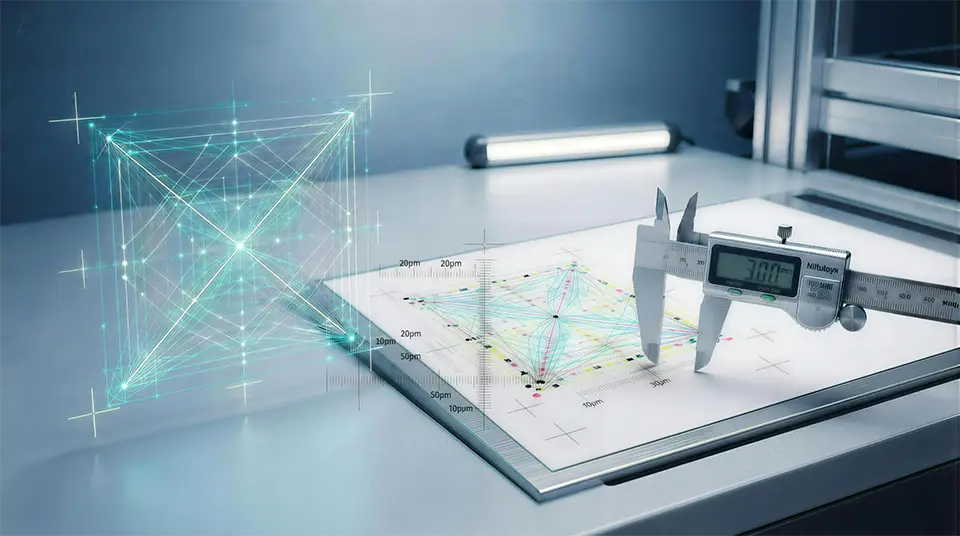
Even the most accurate colour reproduction becomes meaningless if the final product suffers from dimensional deviations, misaligned folds, or skewed binding. Geometric precision is a core quality attribute that governs how a virtual design transforms into a tangible substrate. It determines whether every line, every cut-out, and every crease is faithfully replicated with micron-level fidelity. Achieving this demands a standardized geometric integration system that runs consistently through prepress, printing, and post-press.
Prepress “Geometric Pre-compensation” – The Origin of Accuracy
Prepress is not solely about colour separation; it is also the starting point for geometry control. Upon receiving the customer’s PDF file, we perform an in-depth geometric structure analysis:
Trapping and Gap Compensation
Trapping values (typically 0.05–0.10 mm) are set according to the tolerance allowed for subsequent die-cutting or folding, preventing white gaps caused by minor register fluctuations.
Pre-compensation for Paper Stretch/Shrinkage
Different paper types (e.g., coated, offset, specialty) expand or contract at varying rates under press pressure and humidity. Based on the paper’s grain direction, we apply reverse compensation during imposition – for example, if the longitudinal shrinkage rate is 0.2%, we elongate the layout by 0.2% so that the finished size matches the nominal dimensions after the paper has returned to equilibrium moisture content.
Unified Gripper and Registration Reference
All imposed files are forced to use the same gripper edge and the same cross-mark system, providing a single mechanical origin for subsequent folding and die-cutting operations.
“Registration and Distortion Monitoring” on Press – The Foundation of Dimensional Stability
On the printing press, we maintain geometric stability through the following measures:
Inline Register Inspection (Non-Colour)
Using registration marks (cross-hairs, corner marks), operators or visual-assist tools verify that four-colour overlay deviations remain within ±0.1 mm.
Tension and Climate Control
Press feeding tension is continuously monitored, and the workshop is kept at 23°C ± 1°C and RH 50% ± 5% to minimise fan-out or waviness caused by moisture fluctuations.
“Position Transfer and Compensation” in Post-press – The Key to Perfect Finished Goods
Folding, die-cutting, and binding must always reference the actual dimensions of the printed sheets, not merely theoretical values:
Folding Machine Reference Transfer
On the first folded sample, front and side lays are adjusted using the printed cross-marks as the reference, ensuring that every crease aligns with the design fold line within ±0.3 mm. For multi-signature folds, we record the post-fold dimensional deviation of each signature and use these data to compensate for thickness build-up during gathering.
Dynamic Die-Cutting Calibration
Die-cutting plates are manufactured based on the measured average sheet expansion/shrinkage from the same production run. The first die-cut piece is measured with a high-precision scanner for contour deviation. If a systematic shift is detected, micro-adjustments are made to the die-cutter’s side guides, allowing windows, rounded corners, and graphic elements to match perfectly.
Binding’s Contribution to Spine Squareness
During thread-sewing or perfect binding, book block squareness is directly influenced by folding accuracy. We measure diagonal differences (≤1 mm) to control overall rectangularity, ensuring that the final book has a vertical spine and that cover creases are free from skew.
Building a Two-Way Geometric Correction Feedback Loop
At every stage, floor quality personnel measure critical dimensions on first-off and last-off samples using callipers, steel rulers, or specialised gauges, recording the data on a Process Geometric Accuracy Tracking Sheet.
When a systematic deviation between the actual post-press size and the prepress theoretical value is detected, quality personnel immediately feed this back to the prepress imposition station to adjust compensation coefficients for subsequent batches.
This human-driven closed-loop correction – while not automated – is highly flexible and leverages human experience to quickly respond to variables such as paper type changes and rush job switches.
Conclusion
Through this standardized integration, we faithfully replicate every micron from the digital file onto the physical finished product, turning precision into a tangible delivery commitment.
STAY IN THE LOOP
Subscribe to our free newsletter.
Leave A Comment

In printing, the effectiveness of process control directly determines the [...]