Sheetfed review
Consider format, paper, component flexibility, color expectations and how individual sheets need to move into later production stages.

Printing Capabilities
Format, page count, paper, color, quantity, binding and finishing requirements guide the choice between sheetfed and web offset.
Request a Quote
02 / Route input
Printing decisions begin with the book that needs to be produced. Format and page count affect how the work is planned and handled. Paper, color requirements and quantity influence which production route may be suitable. Binding, finishing and the intended result also matter because the printed work must support the next production stage.
Anhui Xin An Printing Co., Ltd. reviews these inputs together before coordinating a route. No single figure determines the answer on its own.
Project specification
Production review
Output
Suitable printing route

03 / Sheetfed route
Sheetfed offset is considered when a book specification calls for flexible sheet handling, a particular format or paper choice, and careful control of illustrated content, covers or other printed components. Projects with demanding color requirements may also make sheetfed production relevant, but the route is reviewed against the complete job rather than treated as the default for every book.
Once sheetfed offset is selected, printing proceeds from the confirmed production files and the reference established upstream. Press output is evaluated in relation to the agreed project requirements so production can continue on a controlled basis.
Sheetfed production resource
04 / Continuous route
Web offset becomes relevant when the format, page count, paper, color requirements, quantity and run structure support continuous production. Larger-volume programs may be suitable, but quantity alone does not determine the route. The complete specification must still be reviewed before web production is selected.
When the route fits, Xin An Printing coordinates the confirmed project requirements through press execution and into the following production stages. Production efficiency is considered within the full job specification, without relying on a universal volume threshold.


Web-printing production context. The photographs do not verify a specific press model.
Supporting production resource
Mitsubishi 787L-BT2-800 Commercial Web Presses support commercial web-offset production.
05 / Color handoff
Prepress establishes the reference used to discuss the expected printed appearance. Printing carries that reference into physical production. Press output is evaluated against the established basis and the agreed job requirements before stable production continues.
This is the execution side of color confirmation. It does not replace file preparation, ICC matching or digital proofing.
06 / Project review
Sheetfed and web offset answer different production conditions. The practical choice comes from the relationship among format, page count, paper, color requirements, quantity, binding, finishing and the intended result. If one requirement changes, the suitable route may change with it.
A project review keeps the decision tied to the actual book rather than to a generic quantity rule or an automatic selector.
Consider format, paper, component flexibility, color expectations and how individual sheets need to move into later production stages.
Consider page count, paper, quantity, run structure and whether continuous production suits the confirmed specification.
Consider binding and finishing consequences, the established visual reference, and the intended finished result before confirming the route.
These points guide a project review. They are not a quotation tool and do not promise an automatic selection.
07 / Production evidence
Verified equipment records show the production resources available to support suitable printing routes. They do not replace project review. On this page, selected images provide production evidence; the Equipment page remains the source for machine identity, model, quantity, configuration and verified specifications.
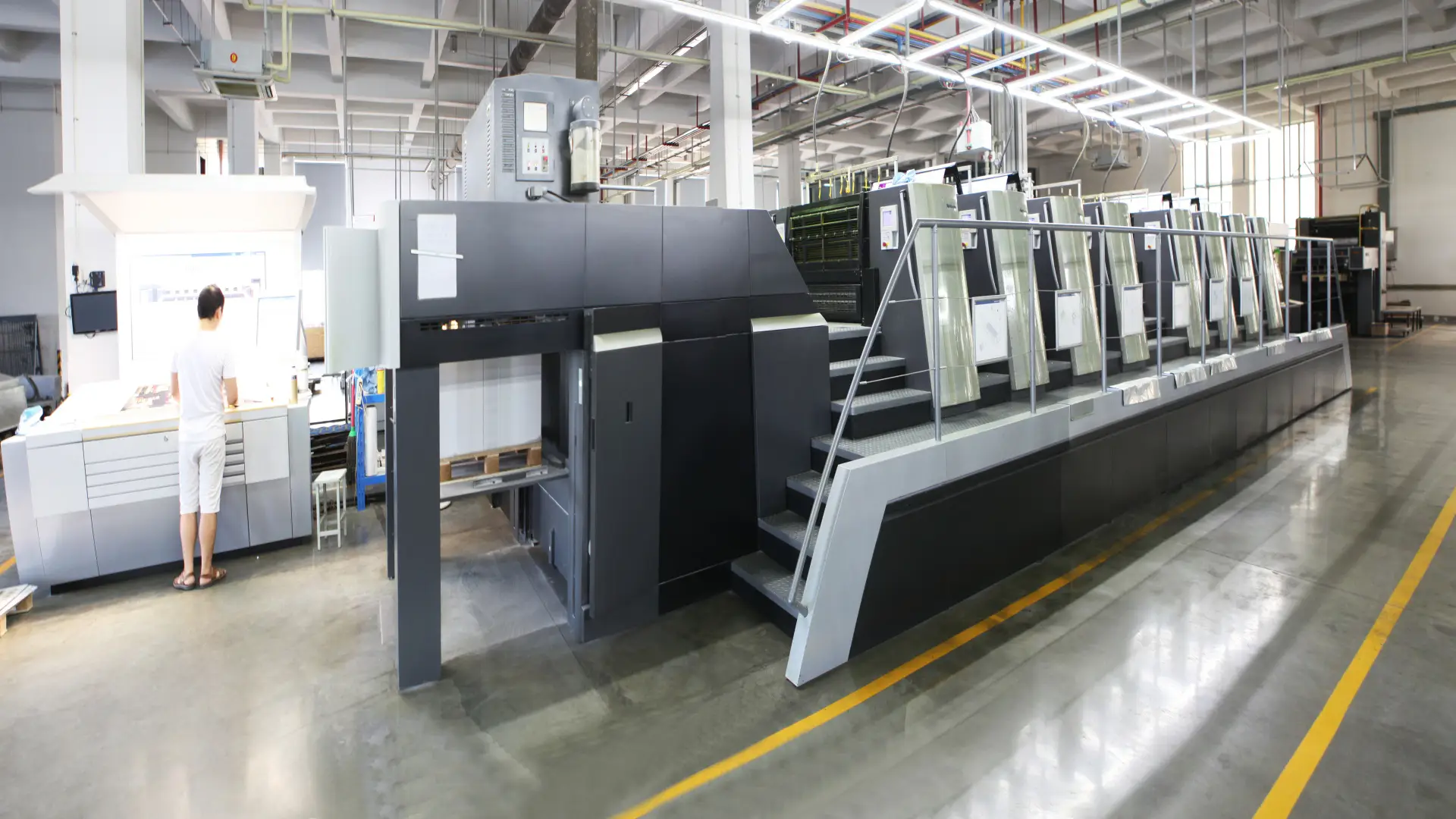
Verified sheetfed resource
Heidelberg Speedmaster XL106-8-P
Supports selected sheetfed offset work. Use its verified photograph as production evidence only; direct readers to Equipment for identity and configuration details.
Verified sheetfed resource
Komori Lithrone G46
Supports selected sheetfed offset work. Its verified production photograph may support the sheetfed route story without becoming a machine card.
Commercial web-offset resource
Mitsubishi 787L-BT2-800 Commercial Web Presses
Support commercial web-offset production. No approved photograph on this page verifies the exact model, so the model reference remains text-only beside clearly labeled context photography.
Send the format, pages, quantity and paper specification so the production route can be reviewed.