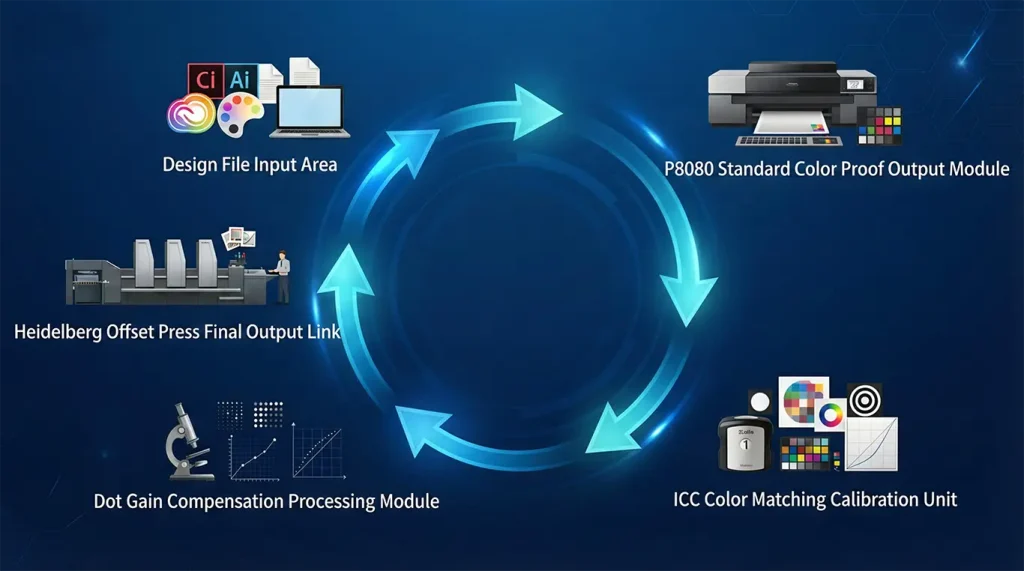

Reliable print production starts with files that match the intended book specification. Artwork may appear correct on screen while still containing conditions that cause problems during imposition, proofing, printing or finishing.
Publishers and designers should check the following areas before sending a book to production.
1. Finished Size
The artwork should match the intended finished trim size. Specify dimensions as Width × Height, for example 210 × 297 mm, so portrait and landscape orientation cannot be confused.
2. Bleed
Artwork that reaches the finished edge should normally extend beyond the trim line. This additional image area is the bleed.
If there is not enough bleed, normal cutting variation may leave an unwanted white edge. Confirm the required bleed for the project before preparing the final file.
3. Fonts
Embed fonts correctly or provide them in a form that will reproduce reliably in production. Missing or substituted fonts can alter line breaks, character shapes, pagination and spacing.
4. Image Quality
Images need sufficient effective resolution at their final printed size. Original pixel dimensions alone do not tell the whole story, since enlarging an image in the layout reduces its effective resolution. Check image quality within the production file.
5. Color Space
Prepare artwork for the intended printing and color-management workflow. RGB content may require conversion or controlled handling before offset production.
For color-critical work, coordinate the file preparation with the proofing and ICC setup used for the project.
6. Overprint
Overprint settings determine how objects interact when printed. Incorrect settings can make objects disappear or cause unexpected color changes, including unintended interactions between black and colored elements.
7. Trapping
Some artwork requires trapping to compensate for small registration variation between colors. The appropriate method depends on the design, printing condition and production workflow.
8. Pagination
Page order must correspond to the final book structure. This is especially important for products made with signatures, Thread Sewing, Saddle Stitching or other imposition-dependent binding methods.
A blueprint or equivalent production proof can be used to confirm page sequence, imposition and content completeness.
9. Binding Requirements
The production file must account for the chosen binding structure. Depending on the book, this may include spine width, cover wrap, flaps, endpapers, case dimensions, die-cut areas or other special cover requirements.
10. Finishing Areas
Processes such as Spot UV, Foil Stamping, Embossing, Debossing, Die Cutting and Kiss Cutting normally need clearly defined artwork areas or separate production layers.
Anhui Xin An Printing Co., Ltd. File Review
File review is part of the production workflow at Xin An Printing. The review does not redesign the customer’s artwork. It identifies file conditions that could affect production before the job reaches the press.